Petter Törnberg

Research on digital platforms, AI, and collective life

petter-tornberg-profile.jpg

Petter Törnberg researches how digital platforms and AI reshape public discourse, political conflict, urban life, and democratic institutions.

His work brings computational social science into conversation with social theory. He is interested in how technologies become part of collective life: how they influence what people see, how groups form, how political conflict travels, and what new forms of power emerge.

This site brings together his research, writing, projects, and conversations in the media.

Questions I Work On

  • Digital politics, misinformation, and polarization
  • Social media governance and platform power
  • Large language models for social science research
  • Urban and platform transformations in digital capitalism

Featured Books

Two books on platform power, far-right extremism, and digital governance.

Cover of Intimate Communities of Hate

Intimate Communities of Hate (Routledge, 2024)

An account of how social media affordances and online group dynamics can sustain far-right extremism.

DOI · Altmetric · Purchase

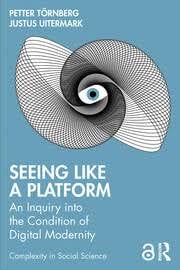
Cover of Seeing Like a Platform

Seeing Like a Platform (Taylor & Francis, 2025)

An inquiry into platform power, governance, and digital modernity.

DOI · Altmetric · Website

Working Across Disciplines

These questions often require more than one kind of evidence. The work combines computational analysis, social simulation, close reading, and conceptual thinking, usually in collaboration with researchers from different fields.

Explore

selected publications

  1. Echo chambers and viral misinformation: Modeling fake news as complex contagion
    Petter Törnberg
    PLoS ONE. Contribution: an early model of misinformation diffusion and echo-chamber dynamics. , 2018
  2. How digital media drive affective polarization through partisan sorting
    Petter Törnberg
    Proceedings of the National Academy of Sciences. Contribution: a mechanistic account of how platform-mediated sorting can intensify polarization. , 2022
  3. NMS
    Inside a White Power echo chamber: Why fringe digital spaces are polarizing politics
    Petter Törnberg and Anton Törnberg
    New Media & Society. Contribution: a framework connecting platform architecture, emotion, and extremist mobilization. , 2022
  4. Large language models outperform expert coders and supervised classifiers at annotating political social media messages
    Petter Törnberg
    Social Science Computer Review. Contribution: a practical benchmark for language-model-assisted annotation in social research. , 2024
  5. When do parties lie? Misinformation and radical-right populism across 26 countries
    Petter Törnberg and Juliana Chueri
    The International Journal of Press/Politics. Contribution: cross-national evidence about party-level misinformation and political strategy. , 2025
  6. White supremacists anonymous: how digital media emotionally energize far-right movements
    Anton Törnberg and Petter Törnberg
    Journal of Information Technology & Politics. Contribution: an affective account of online radicalization in digital politics. , 2025
  7. BDS
    Artificial intelligence and the state: Seeing like an artificial neural network
    Petter Törnberg, Ola Söderström, Jennifer Barella, and 2 more authors
    Big Data & Society. Contribution: a bridge between AI governance and social theories of state power. , 2025
  8. AIR
    Validation is the Central Challenge for Generative Social Simulation: A Critical Review of LLMs in Agent-Based Modeling
    Maik Larooij and Petter Törnberg
    Artificial Intelligence Review. Contribution: a methodological case for validating generative social simulations. , 2025
    Published version; preprint available on arXiv